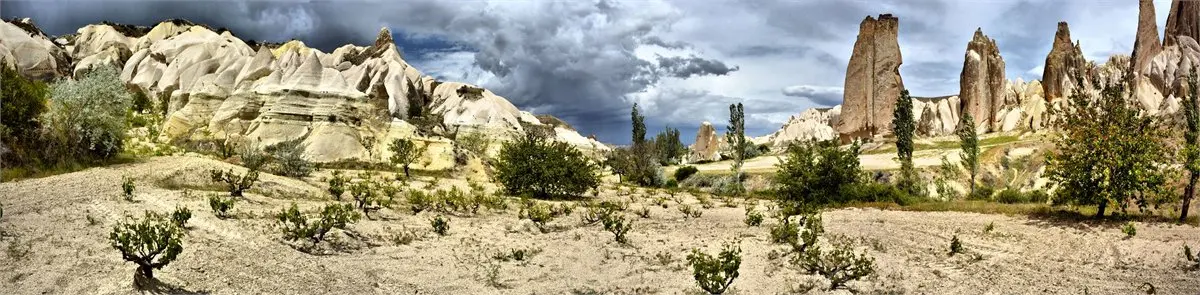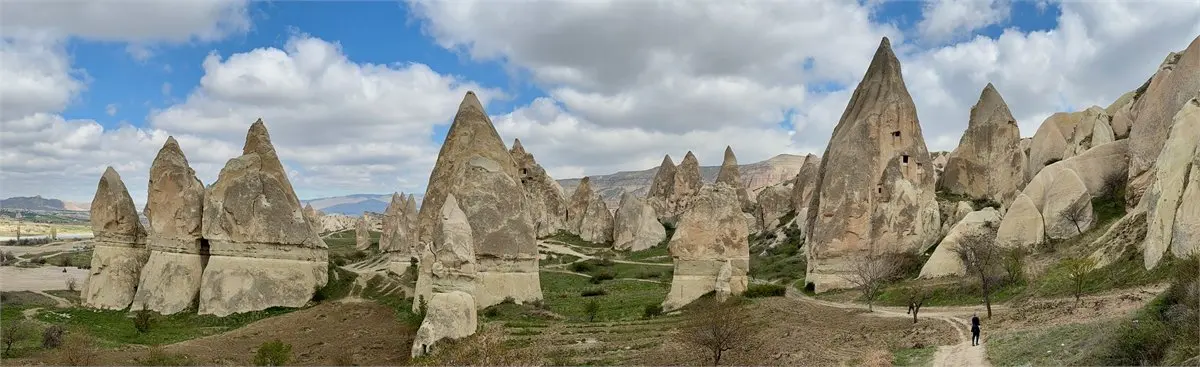
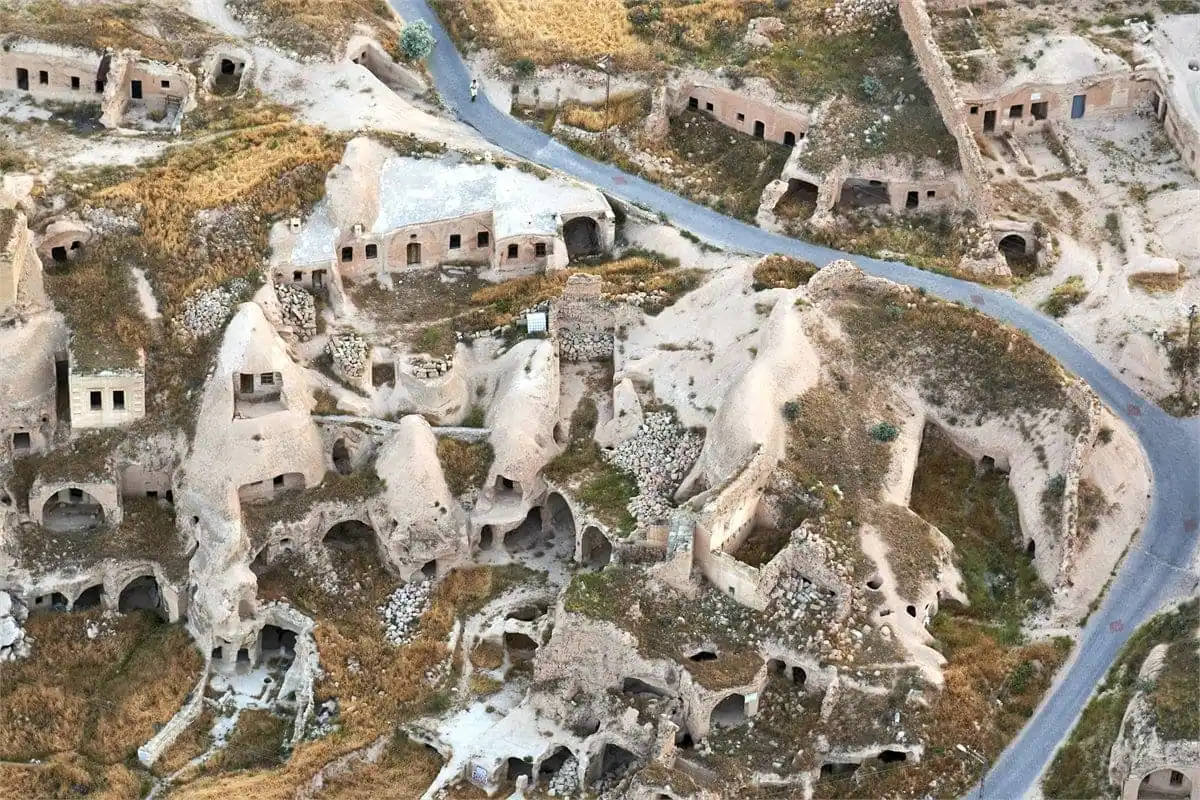
Göreme National Park is the protected heart of Cappadocia in central Türkiye: the landscape of fairy chimneys, rock-cut churches and cave villages between the towns of Nevşehir, Ürgüp and Avanos. UNESCO added it to the World Heritage List in 1985 as “Göreme National Park and the Rock Sites of Cappadocia”, a property of 9,883.81 hectares. There is no single ticket for it: the valleys are free to walk, while individual sites such as the Göreme Open Air Museum charge their own entrance fee.
The name confuses many visitors, because it sounds like one place with a gate. It is really the whole core of the region, with villages, roads, hotels and vineyards inside it. Below we explain where Göreme National Park is, what the UNESCO listing includes, how it differs from the Open Air Museum, and how to see the best of it.
Where is Göreme National Park located?
It lies on the central Anatolian plateau, in Nevşehir province, about 730 km southeast of Istanbul (see where is Cappadocia for the wider map). UNESCO describes the core as the area between Nevşehir, Ürgüp and Avanos, with the village of Göreme near its center. Two extinct volcanoes frame the horizon: Erciyes (3,916 m) to the east and Hasan (3,253 m) to the southwest. Their ash, compacted into soft tuff and carved by wind and water, made the fairy chimneys; our article on how the fairy chimneys formed tells that story.
The nearest airports are Nevşehir (NAV) and Kayseri (ASR). Our how to get to Cappadocia guide covers flights and transfers, and the Cappadocia map shows drive times between the villages.
Is Göreme Historical National Park still a national park?
Not in the legal sense, although the name lives on. Türkiye declared the area the Göreme Historical National Park in 1986. In 2019, Law No. 7174 on the Cappadocia Area, adopted on 23 May 2019, brought the protection, planning and management of the whole area under one body, the Cappadocia Area Presidency, headed by the Governor of Nevşehir. The national-park status was lifted by presidential decision in October 2019. The UNESCO World Heritage listing did not change, and UNESCO still uses the name Göreme National Park, which is why you will see it on maps, signs and guidebooks.
Göreme National Park is not a place with a gate. It is the whole valley system you will spend your trip inside.
What does the UNESCO site include?
The listing has two parts. The large one is the Göreme valley system and its surroundings. The smaller ones are separate rock sites further out: Karain, Karlık, Yeşilöz, the Soğanlı valley, and the underground cities of Kaymaklı and Derinkuyu. In total, UNESCO counts two underground towns, five troglodyte villages and more than 200 registered rock-cut churches.
UNESCO lists it under four criteria, three cultural and one natural. The cultural ones recognize the painted churches as unique evidence of Byzantine art after the Iconoclast period, the cave villages as a fossilized picture of a Byzantine province from the 4th century to 1071, and the region as an outstanding traditional settlement. The natural one recognizes the hoodoo landscape itself. Monastic life began here in the 4th century, and the best-known painted churches date from the 10th to the early 13th centuries: Tokalı and El Nazar, St Barbara and Saklı, and Elmalı and the Dark Church (Karanlık Kilise). Our churches of Cappadocia article explains what you are looking at.
Göreme National Park vs the Göreme Open Air Museum
This is the most common mix-up. Göreme National Park is the whole protected landscape, many kilometers across. The Göreme Open Air Museum is one ticketed site inside it: a monastic complex of rock-cut churches about 1.5 km uphill from Göreme village, run by the Ministry of Culture and Tourism. If a tour says it “visits Göreme National Park”, ask which sites it actually enters.
Göreme National Park entrance fee: is there one?
No. There is no ticket for the park as a whole, and the valleys, viewpoints and walking trails cost nothing. You pay at individual state sites inside it: the Göreme Open Air Museum (with the Dark Church as a separate ticket), the Zelve Open Air Museum with Paşabağ on one ticket, and the Derinkuyu and Kaymaklı underground cities. Uçhisar and Ortahisar castles charge small local fees.
The Ministry sets those prices and changes them every year. From 1 April 2027 foreign visitors pay €22 at the Göreme Open Air Museum (the Dark Church is a separate €7 ticket), €13 for Zelve–Paşabağ and €15 at Derinkuyu or Kaymaklı; until 31 March 2027 the prices posted at the gates apply. Our Cappadocia entrance fees from 1 April 2027 page lists the rest and explains the Museum Pass.
What to see in Göreme National Park
- The painted rock churches of the Göreme Open Air Museum, the best-preserved group in the region.
- Uçhisar Castle, the highest point, with a view across the whole park.
- The fairy chimneys of Paşabağ and Devrent (Imagination Valley).
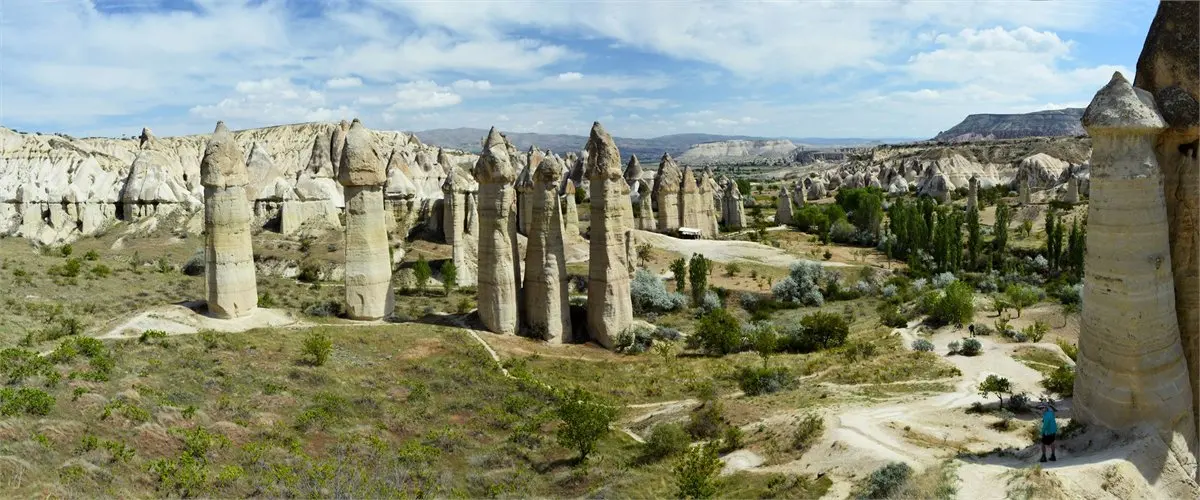
- Love Valley and Pigeon Valley, both easy to walk from Göreme.
- The old cliff village of Çavuşin and the abandoned valleys of Zelve.
- At dawn, on calm mornings, the hot air balloons over the valleys.
Can you see hot air balloons in Göreme National Park?
Yes. Balloons launch at dawn from fields around Göreme and drift over the park’s valleys whenever the wind allows. You can fly on a Cappadocia hot air balloon ride or watch from the ground on our Cappadocia sunrise tour. Flights depend on the wind, so check our balloon forecast before you plan the morning.
How to visit Göreme National Park with a local guide
Most of the park’s famous sites sit within a short drive of Göreme, so one well-planned day covers the core. Our Cappadocia Red Tour takes in the Open Air Museum, Uçhisar, Paşabağ, Devrent and Avanos. The Cappadocia Green Tour goes south to Derinkuyu, one of the listed underground cities. If you would rather walk, the Cappadocia hiking tour follows the valley trails on foot. Every tour includes skip-the-line entry, and ticket costs are quoted separately at the state price.
Sources & further reading
- UNESCO World Heritage Centre — Göreme National Park and the Rock Sites of Cappadocia — inscription in 1985, the four criteria, the 9,883.81 ha property, its boundaries and component sites, and the dates of the painted churches
- Cappadocia Area Presidency (Ministry of Culture and Tourism) — Law No. 7174 on the Cappadocia Area — the law adopted on 23 May 2019 that governs the protection, planning and management of the area
- DergiPark — Conservation and planning processes of cultural and natural heritage sites in Cappadocia (academic article) — the 1986 Göreme Historical National Park status, its cancellation in October 2019, and the Governor of Nevşehir heading the Cappadocia Area Presidency