
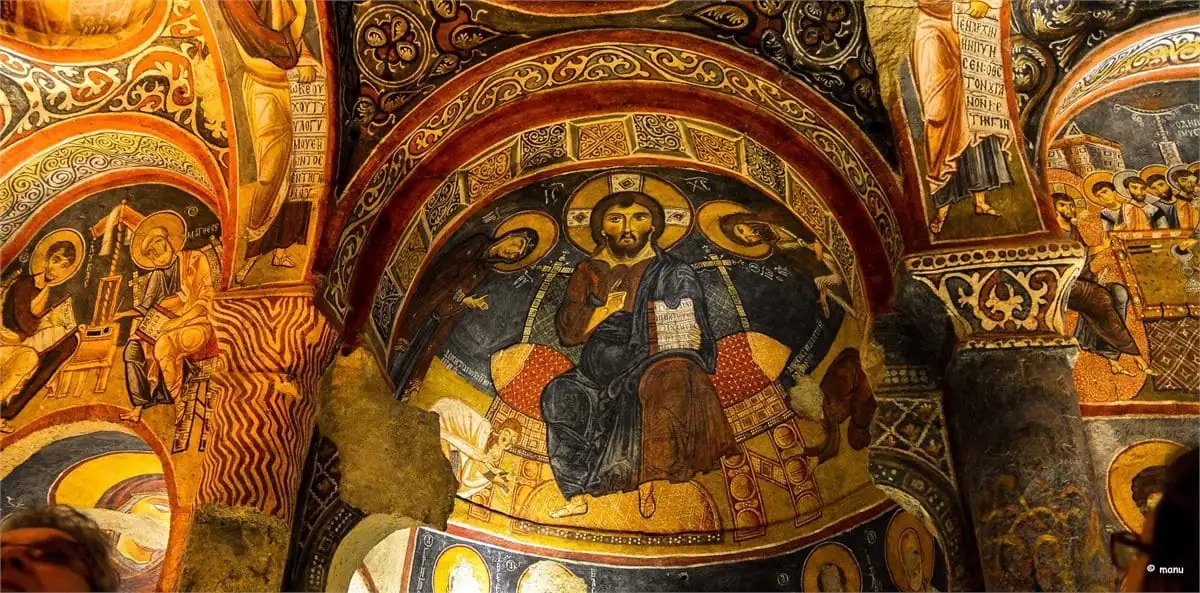
The Karanlık Kilise — the Dark Church — is small enough that a dozen visitors fill it, and important enough that scholars cross continents for it. It owes both its name and its survival to the same accident of architecture: the builders gave it almost no windows, and the darkness that made worship candlelit also stopped a thousand years of sunlight from eating the paint.
What you see inside is an almost complete eleventh-century decorative program in colors that have barely faded: deep lapis blues ground from imported stone, ochres and earth greens, whites that still read as linen rather than plaster. In most surviving Byzantine churches you reconstruct the original effect in your imagination. Here you simply look at it.
Reading the walls
The program follows the classic middle-Byzantine script. In the central dome, the Christ Pantokrator — the Ruler of All — looks down with the book of judgment; around and below him unfold the great feast scenes: the Annunciation, the Nativity with its thoughtful midwives and puzzled Joseph, the Baptism, the Transfiguration, the Raising of Lazarus, the Crucifixion, the Anastasis. On the vaults and arches, rows of saints stand witness. The donors who paid for the work are here too, small figures presenting their church to Christ — insurance for the soul, signed in pigment.
It repays slowness. Find the shepherd’s dog at the Nativity. Notice how the painter individualized the apostles’ faces at the Last Supper. Look for the seams where the plaster days met — a fresco is painted against the clock, wet, and you can almost hear the workshop arguing.
The restoration and the rules
The church spent part of its later life — this is true of half the chapels in Cappadocia — as a pigeon house, and it took restorers fourteen years to lift the droppings and soot without lifting the paint. The result is the region’s benchmark restoration. The house rules protect it: a separate timed ticket keeps numbers low, and photography is banned outright — flash chemistry and lapis do not negotiate. Buy the postcard; it was shot with better lights than yours anyway.
See it as part of the Göreme Open Air Museum — it sits at the heart of the loop path, and on our Red Tour we time the visit for the quietest window of the morning.
Sources & further reading
- UNESCO: Rock Sites of Cappadocia — heritage context
- Britannica: Cappadocia — historical overview