
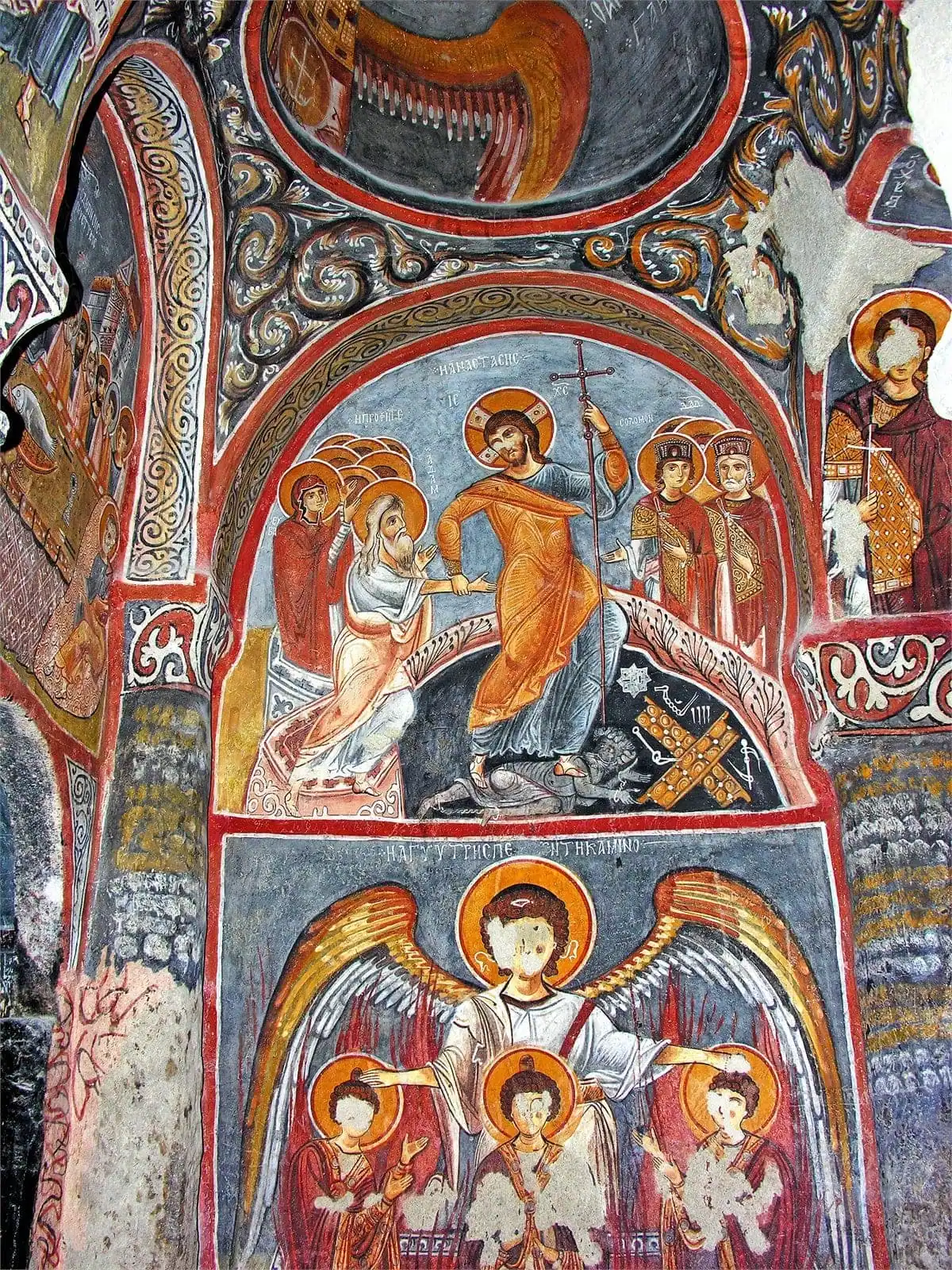
Christianity arrived in Cappadocia almost as early as Christianity existed — the region is greeted by name in the New Testament’s first letter of Peter — and it found here a landscape uniquely willing to cooperate. Rock that could be carved with hand tools meant a congregation needed no quarry, no timber, no architect: only patience and a wall to start on. The result, a thousand years later, is the densest concentration of medieval churches anywhere on earth.
The Fathers in the wilderness
In the 4th century this quiet plateau briefly steered all of Christian thought. Basil of Caesarea — bishop of today’s Kayseri — with his brother Gregory of Nyssa and friend Gregory of Nazianzus formed the trio history calls the Cappadocian Fathers, whose work anchored the doctrine of the Trinity at the Council of Constantinople in 381. Basil did something else with local consequences: he championed monastic life organized in communities rather than lone heroics, and his native rock obliged. The valleys filled first with hermits’ hollows, then with organized monasteries — refectories, kitchens and chapels carved as one — of which Göreme is the supreme surviving example. To see where the Fathers sit in the longer story, follow a timeline of Christianity in Turkey.
The argument about images
Many painted faces here are scratched out, and the damage itself is history. In the 8th and 9th centuries the Byzantine empire tore itself apart over whether sacred images were devotion or idolatry — iconoclasm, the image-smashing — and Cappadocia’s churches record both the austere cross-only decoration of the ban years and the joyous figurative flood after images were restored in 843. Later, humbler damage followed: centuries of shepherds’ fires, pigeon lofts and scratched names after the churches fell out of use. Reading the layers of harm is, oddly, one of the richest ways to read the region.
How to read a fresco
The mature churches follow a shared script, and knowing it transforms visiting. Look up: Christ Pantokrator, the Ruler of All, holds the dome. The great feasts of the church year — Annunciation, Nativity, Baptism, Transfiguration, Crucifixion, Resurrection as the harrowing of hell — wrap the vaults in narrative order. Saints rank the lower walls, where hands could touch them; donors kneel small in corners, purchasing remembrance; and warrior saints George and Theodore spear serpents by the door, on guard. Styles range from the metropolitan polish of the Dark Church to the flat, vivid, almost Egyptian manner of the Ihlara chapels — one faith, many hands, and the whole spectrum within a day’s driving.
See the masterpieces with context on the Red Tour, or the remote and lonely ones on a tailor-made day — some of the region’s most affecting churches have no ticket booth, no lighting and no company but yours.
Sources & further reading
- Britannica: the Cappadocian Fathers — the theological story
- UNESCO: Rock Sites of Cappadocia — the churches in the listing
- Britannica: the Iconoclastic Controversy — why the images were fought over