
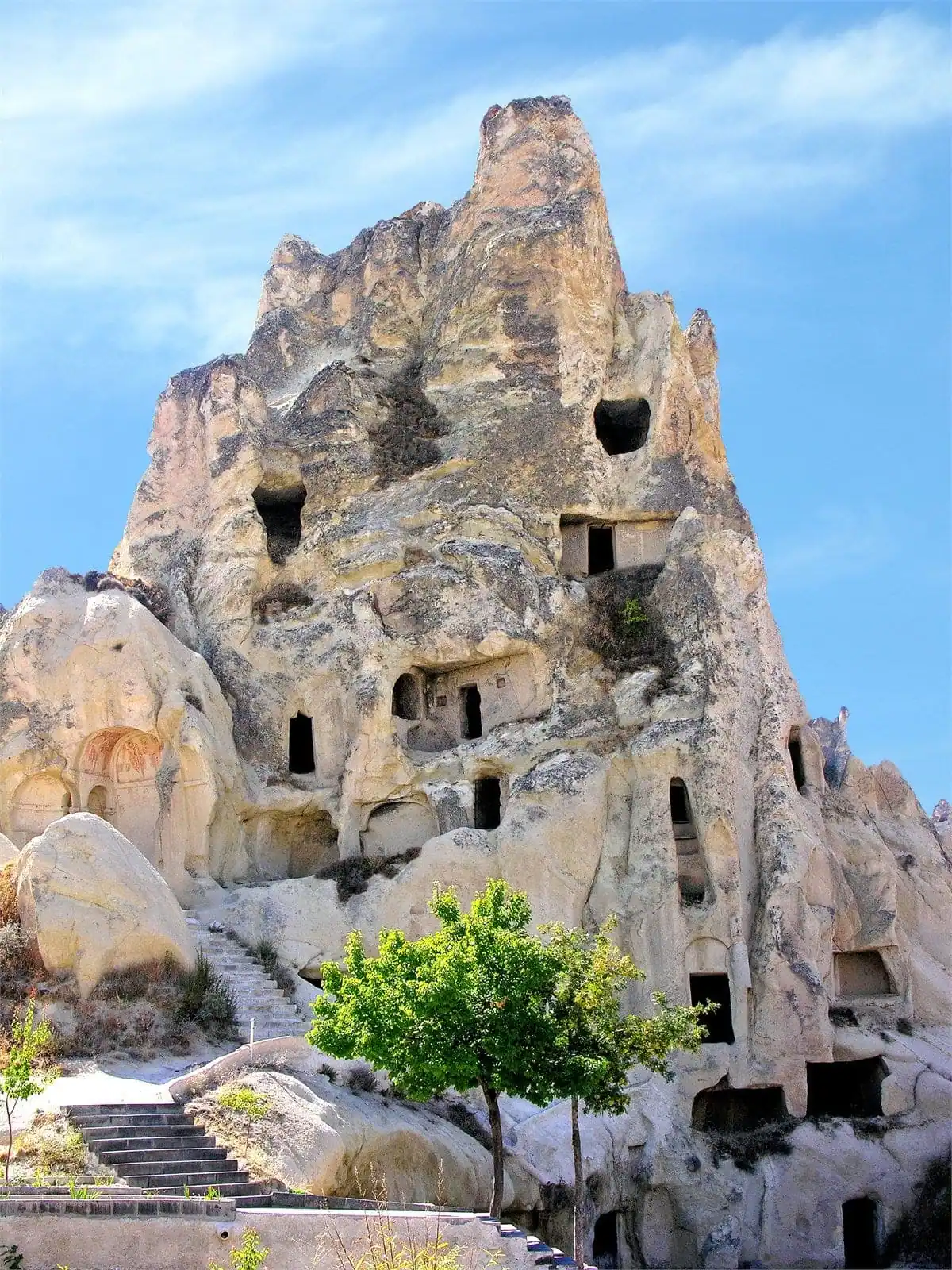
The Göreme Open Air Museum is a UNESCO World Heritage rock-cut monastic complex 1.5 km uphill from Göreme town in Cappadocia, Turkey, open daily 08:00–18:45, and it takes about two hours to walk. Between roughly the tenth and twelfth centuries, monastic communities carved everything they needed out of the soft tuff — churches, dining halls with rock-cut tables, kitchens, cells — and painted the churches with a skill that had no business surviving a thousand years of earthquakes, smoke and graffiti. Much of it survived anyway. Our licensed guides walk the valley with you in about two hours.
The museum is a loop path connecting a dozen or so major spaces. Most visitors walk it in ninety minutes; with a guide who can read the paintings it comfortably fills two hours, because the walls stop being decoration and start being an argument — about images, about doctrine, about who paid for what and why.
The churches that matter most
The Elmalı (Apple) Church is the best introduction: a compact cross-in-square with a Christ Pantokrator in the dome and its colors largely intact. The Karanlık (Dark) Church next to it is the masterpiece — see below. The Yılanlı (Snake) Church shows St George and the dragon along with a famously enigmatic figure of St Onuphrius; the Çarıklı (Sandal) Church takes its name from the footprints pressed into the floor beneath the Ascension fresco. And the Tokalı (Buckle) Church — just outside the main gate, included in the ticket, skipped by half the visitors who do not realize — is the largest and, in its “new church” section, painted in a lapis blue that stops people mid-sentence.
The Dark Church question
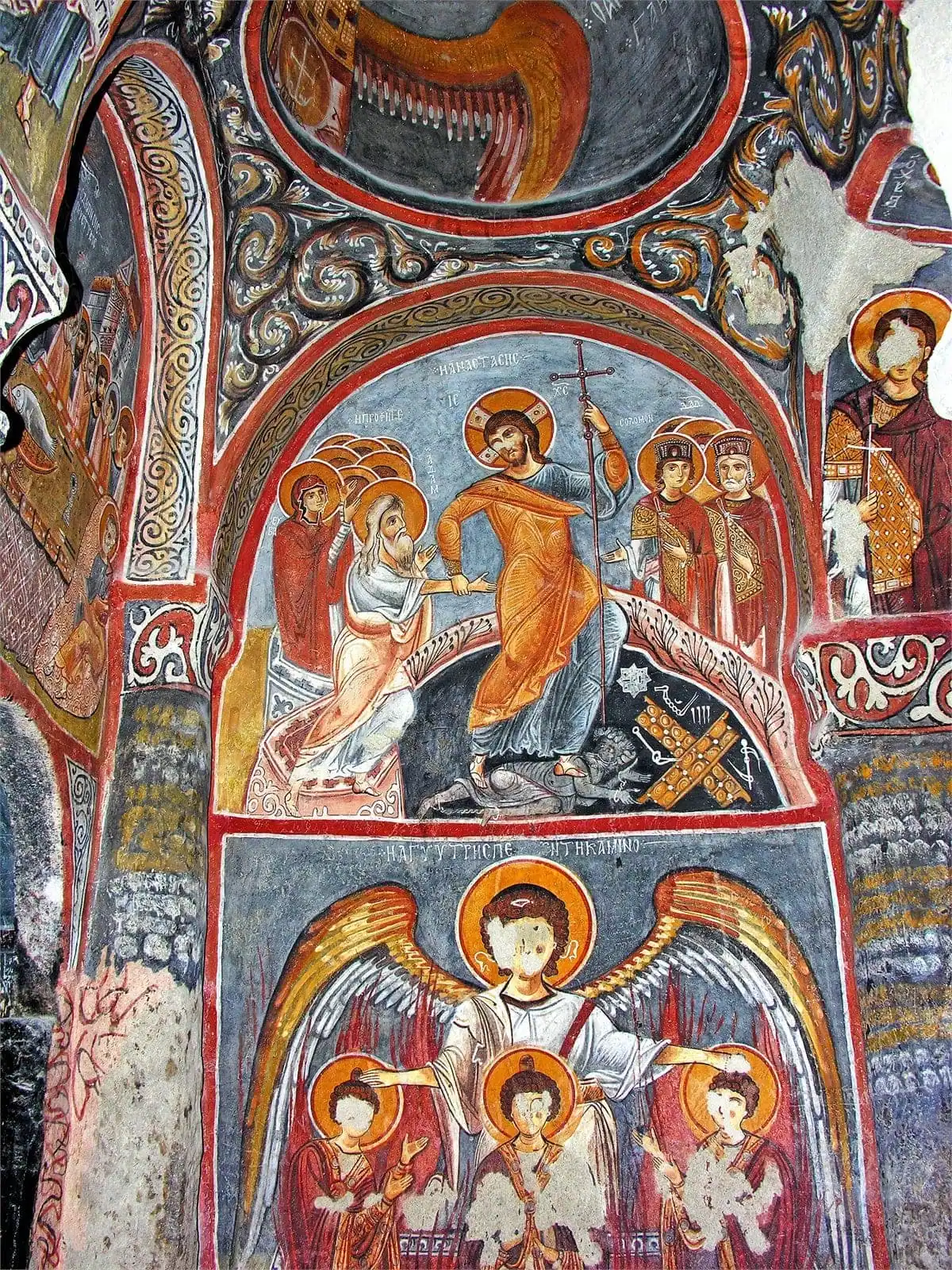
The Karanlık Church takes a separate ticket on top of museum entry, and everyone asks whether it is worth it. It is, without hesitation. The church received almost no daylight — one small narthex window — which is exactly why its frescoes kept a saturation the others lost. Walking in feels like opening a manuscript that was shut in 1200. The extra fee also caps the crowd, so you will often have its Nativity and Crucifixion nearly to yourself.
Why the faces are scratched
You will notice gouged eyes and scraped faces on many figures. Some damage is Byzantine iconoclasm — the empire’s own eighth- and ninth-century war on images. More is simply later centuries of shepherds, soot and souvenir-scratching, before anyone thought of the valley as heritage. Your guide can tell the layers apart; it is one of the small pleasures of the place that the vandalism itself is now historical.
Visiting well
The museum opens early and the coach waves arrive from about 09:30 until early afternoon. The two calm windows are first thing at opening and after 15:00 — the light in the valley is warmer then anyway. Paths are stone, polished by feet; the churches are up short flights of steps. Photography without flash is allowed in most spaces but not in the Dark Church. And bring water: the valley is a sun trap by noon. Every Red Tour we run times this place against the crowd, not the clock.
Sources & further reading
- UNESCO: Göreme National Park and the Rock Sites of Cappadocia — World Heritage listing
- Turkish Ministry of Culture — Göreme Museum — official visitor information, including the published 08:00–18:45 daily opening hours