
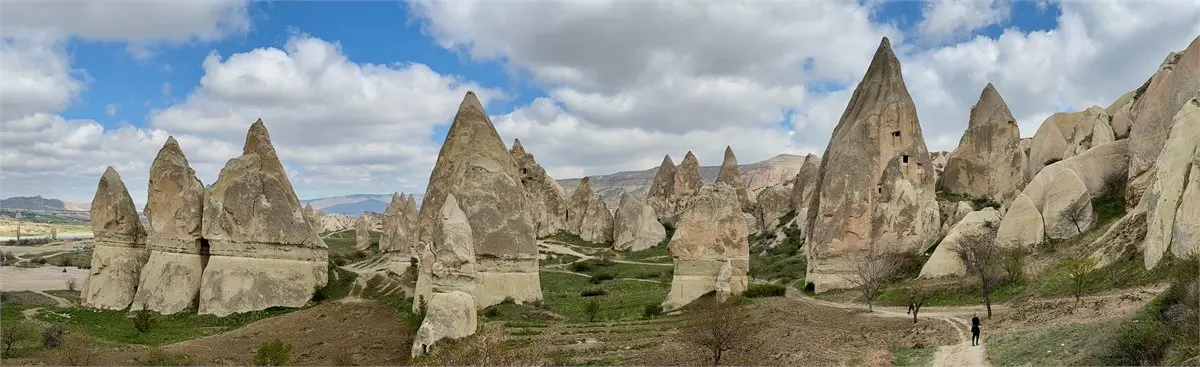
Paşabağ — “the Pasha’s vineyard”, and vines do still grow between the cones — holds the most architecturally improbable fairy chimneys in Cappadocia: thick tuff columns carrying two or even three basalt caps apiece, like families balancing on each other’s shoulders. Geology textbooks use photographs of this valley; so does every travel brochure ever printed about Türkiye.
The mechanics deserve a sentence, because they are elegant: a hard boulder shields the soft ash beneath it while the surrounding land erodes away, and where one column happens to trap several boulders at different heights, it grows several caps. Each chimney is a countdown — when the cap finally falls, the column melts away within a few thousand years. Everything you see here is temporary; it is just being temporary very slowly.
The hermit in the chimney
In the fifth century — so the tradition runs — the hermit Simeon retreated here from accusations of false miracles, and carved himself a cell ten meters up one of the triple-capped chimneys, reachable only by a chute he could defend with silence. The chimney still holds his chapel and living room, and you can climb the worn steps into the lower chamber. Monastic settlement followed him, which is why maps also call this Monks Valley; keep an eye out for the chapel with a seat carved for a stylite — a hermit whose vocation was, precisely, sitting on top of things.
Visiting
The valley is compact and flat — sandy paths wandering between the cones, a vineyard, a gendarmerie post picturesquely installed inside a chimney. Forty-five minutes covers it; photographers stretch to ninety. It sits ten minutes from Devrent Valley, and every Red Tour pairs them as a matinée double bill. Coach pressure peaks late morning; late afternoon the tour buses are gone and the low sun turns the cones the color of bread crust.
Sources & further reading
- UNESCO: Rock Sites of Cappadocia — heritage listing
- Britannica: Cappadocia — background