
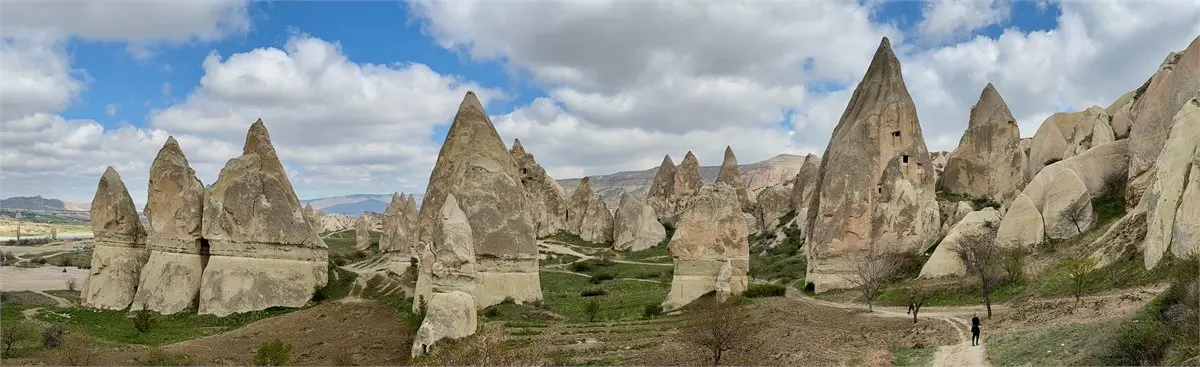
Stand anywhere in the valleys and you can read the whole story in two colors: pale rock below, dark rock on top. The pale stuff is consolidated volcanic ash — tuff — soft enough to carve with hand tools, which is why Cappadocia is full of holes. The dark caps are lava-born basalt, hard enough to shrug off a million winters. A fairy chimney is simply what happens where the second kind of rock protects a column of the first.
The raw material arrived roughly ten million years ago, when three volcanoes ringing the plateau — Erciyes above Kayseri, Hasan to the south-west and the Göllüdağ complex between them — took turns burying central Anatolia in ash. Eruption after eruption laid down beds of tuff hundreds of meters thick, occasionally roofed with sheets of harder lava and ignimbrite. Then the volcanoes quietened, the climate went to work, and the slow half of the story began.
Erosion, the sculptor
Tuff dissolves grief-free: rain softens it, meltwater gullies it, frost pops its surface grain by grain, and the plateau’s flash streams carry it away by the valley-load. Wherever the hard capstone survived, it sheltered the ash directly beneath while everything around washed out — first ridges, then fins, then freestanding cones, each wearing its protective boulder like a hat. The word Turks use is peribacası, fairy chimney, from an older and more sensible assumption that something magical must be responsible.
Local variation explains the valleys’ different characters. Where the cap rock is continuous, you get table mountains and the great castle rocks of Uçhisar and Ortahisar. Where it broke into boulders, cone fields like Paşabağ — whose chimneys trapped several boulders at different heights and grew multiple caps. Where the ash beds were unusually thick and even, the forty-meter giants of Love Valley. And where there was never much cap at all, the soft animal shapes of Devrent, sanded into a zoo.
A landscape with a countdown
Every chimney is temporary. The moment erosion undercuts the cap enough that it topples — you will see fresh-fallen caps at the base of several formations — the unprotected column melts away in a few thousand years, geologically an afternoon. But the same rains are busy carving the next generation out of the valley walls behind. Cappadocia is not a finished monument; it is a production line running at a speed our lifespans cannot perceive, which might be the most pleasing fact in the region.
The human chapters — the carving of churches and cities into all this soft stone — belong to their own stories: see the underground cities, the cave churches and the full history of Cappadocia. And to watch the geology from the inside, walk it with us on the valley hike, where the rock explains itself underfoot better than any page can.
Sources & further reading
- UNESCO: Göreme National Park and the Rock Sites of Cappadocia — geological significance statement
- Britannica: Cappadocia — regional geology overview