
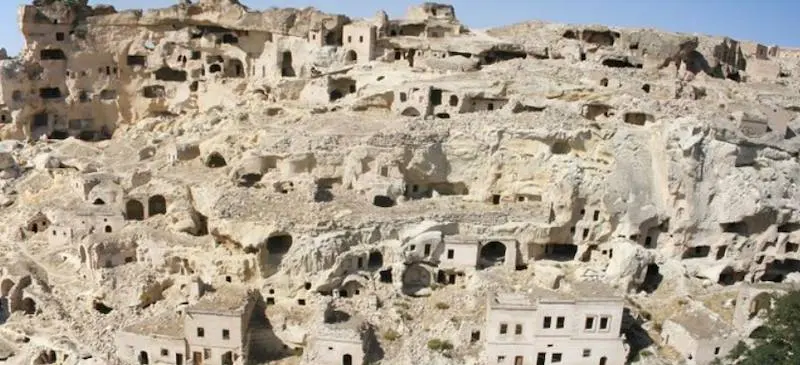
Çavuşin is two villages wearing one name. At road level, a small working town — tea house, tractor, bakery. Behind it, rising like a section cut through history, the old village: a cliff face perforated with centuries of cave homes, connected by rock stairs and terraces, abandoned in stages through the twentieth century as rockfalls made the honeycomb unsafe.
You can climb into the lower reaches of the old village on worn paths — through doorways into rooms with soot-black ceilings, past niches that held oil lamps, up staircases that end mid-air where a house fell away. It is the most direct time travel in Cappadocia precisely because nothing has been curated: no barriers, no interpretive panels, just the evidence.
The basilica at the top
Crowning the cliff is the basilica of St John the Baptist — by most reckonings one of the oldest and largest cave churches in the region, cut around the fifth century when Cappadocian Christianity was young and ambitious. Its columned facade has partly collapsed, which lets afternoon light pour into a nave that once needed lamps, and the scale astonishes: this is not a hermit’s chapel but a pilgrimage church, built big because it expected crowds. It got them for a thousand years; now it mostly gets you.
A second painted church — the Great Pigeon House church, with rare frescoes naming the emperor Nikephoros Phokas, who passed through in 964 — sits by the road below and takes a small ticket.
Visiting
Çavuşin sits five minutes from Göreme on the Avanos road, and the coaches mostly pass it — their loss and your gain. Our valley hike ends here for exactly that reason, and on quieter tailor-made days it makes the perfect crowd-free substitute for a busy museum hour. Wear proper shoes for the climb: the paths are original, which is to say uneven, polished and honest.
Sources & further reading
- UNESCO: Rock Sites of Cappadocia — heritage context