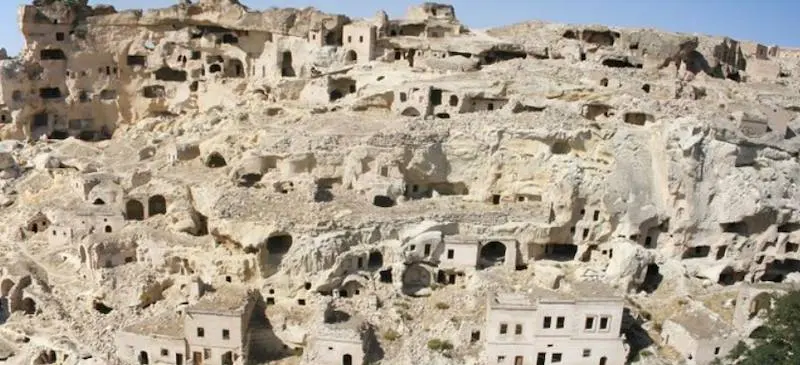
Mustafapaşa is a village of about 1,300 people in Cappadocia, 5 km south of Ürgüp, known until the 1920s as Sinasos — a prosperous Greek Orthodox town whose carved stone mansions, churches and rock-cut chapels still stand. Türkiye’s Ministry of Culture and Tourism describes it as resembling an open-air museum of civil architecture, and in 2021 it was one of the 44 villages on the first Best Tourism Villages list of the UN World Tourism Organization.
It is not a ticketed monument and it is not on the classic tour loop, which is exactly why we like it. Most visitors spend their days among the fairy chimneys and the Göreme Open Air Museum, sleep in Göreme or Ürgüp, and never take the short road south. Mustafapaşa shows a different Cappadocia: not cave dwellings, but stone houses with carved doorways, balconies and painted rooms, built by a town that grew rich far from home.
Mustafapaşa or Sinasos: why two names?
Sinasos was the Greek name, and you will still see it on hotel signs and in books. In the nineteenth century the town was home to Orthodox Christians — the Rum — and Turks. According to the village municipality, many Sinasos families made their living away from Cappadocia, in trade in Istanbul, including caviar, and sent money home; that money is in the mansions you walk past today. The municipality counts nearly 700 stone mansions in the town before the 1920s.
That world ended with the population exchange between Greece and Türkiye. Figures from the exchange commission, quoted by the municipality, show the Greek population falling from 4,500 in 1890 to 878 by 1924. The departing families settled in Greece and founded Nea Sinasos — New Sinasos. Turkish families arrived in their place from Jerveni and Kastoria, near Thessaloniki. The same chapter of history emptied old Çavuşin and the Greek quarters of Ürgüp; our history of Cappadocia puts it in the longer story.
The new name honors an Ottoman official, Seyyid Mustafa Pasha, who is credited with ending the village’s water shortage by having fountains built; the inscriptions carrying his name date to 1804. The municipality says the village elders adopted the name in the 1920s, and it became official in 1966.
Mustafapaşa is Cappadocia without the fairy chimneys in the foreground: a town of masons, merchants and carved stone.
What to see in Mustafapaşa
The village is small enough to walk in an hour or two, and most of what matters is outdoors. The Ministry’s guide picks out these:
- The stone mansions. Nineteenth-century houses with carved facades, balconies, window frames and, inside some of them, wall paintings. Several are now guesthouses and hotels, so you can see the courtyards over a coffee.
- The Church of Constantine and Helena. The big nineteenth-century church in the center, its walls carved with vines, a two-winged dragon, a two-headed eagle and cherubim. Access to the interior varies, so we check on the day; the carved exterior is the main event either way.
- The Mehmet Şakir Paşa Madrasa. A nineteenth-century building that once served as a soup kitchen for the needy and now houses Kapadokya University.
- The Grand Mosque and the Maraşoğlu Bridge. The seventeenth-century cut-stone Cami-i Kebir in the center, and the old stone bridge joining two of the village’s neighborhoods.
- The Doll Museum. The Cappadocia Art & History Museum, a private museum affiliated with the Ministry, is known for its collection of dolls in traditional dress — the village still makes the handmade dolls called kitre.
If churches are your reason for coming to Cappadocia, our guide to the churches of Cappadocia explains how these late Orthodox buildings relate to the much older rock-cut churches at Göreme.
Monastery Valley and the rock-cut churches
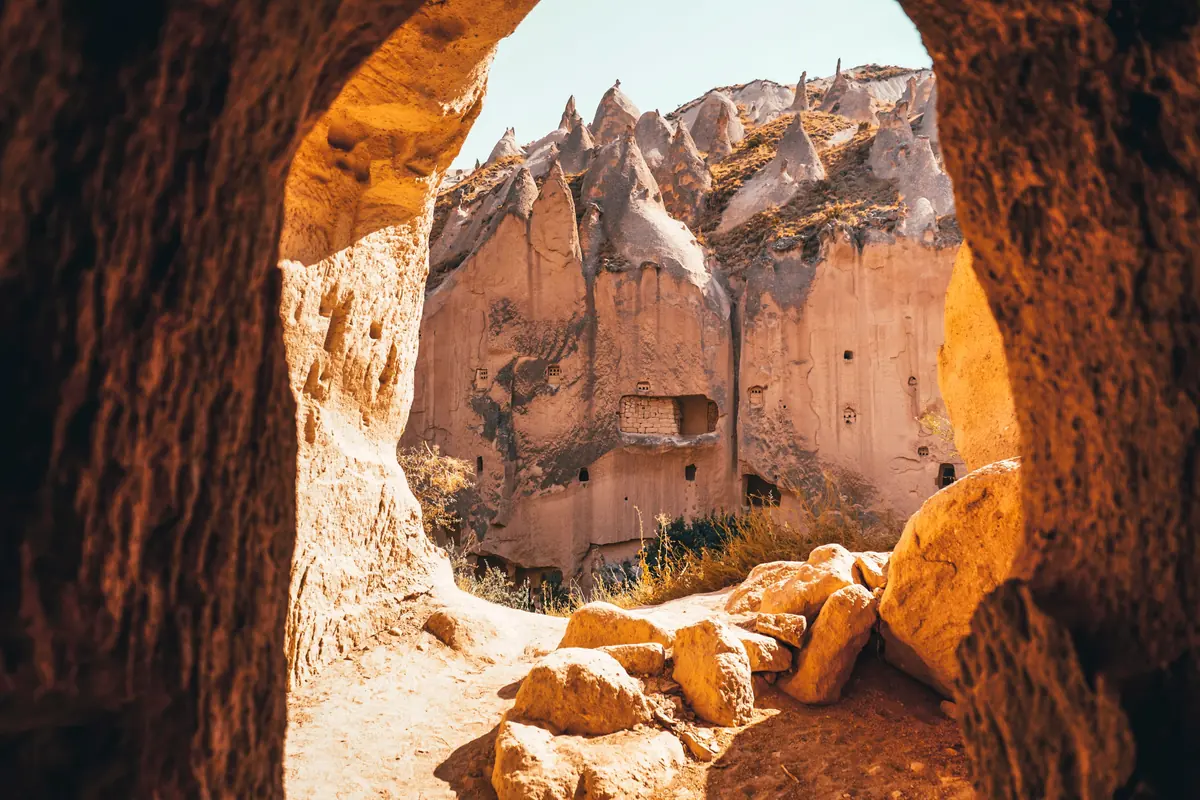
Mustafapaşa sits in a bowl of five hills and valleys, and the Ministry counts two public churches and more than 30 chapels built by the town’s Orthodox community, plus many places of worship carved straight into the rock. The best known are in the Manastır (Monastery) Valley: the Monastery of Agios Nikolaos and the Church of Agios Stefanos.
This is walking country rather than a museum. Paths are informal and signage is thin, so go with someone who knows the way or keep it short. If you enjoy this kind of ground, our Cappadocia hiking tour covers the better-known valleys around Göreme, and a private day can end with an hour in Monastery Valley.
Is Mustafapaşa worth visiting?
Yes — if you have more than two days, or if architecture and history interest you more than another fairy chimney viewpoint. In our experience the village is quiet even when Göreme is full, and an afternoon here changes how you read the whole region: the cave villages were only half the story. On a first, short visit we would still put the big valleys and the underground cities first; our Cappadocia itinerary shows where a village like this fits on day three.
October is a good month for it. The grape harvest happens in autumn, and the village is known for viticulture and the local Emir grape — our article on Cappadocia wine covers the grapes. Pottery, ceramics and doll-making are its crafts; there is more on those in crafts of Cappadocia.
How to get to Mustafapaşa from Göreme and Ürgüp
Mustafapaşa is about 5 km south of Ürgüp, which in our experience is around ten minutes by car; from Göreme add the short drive to Ürgüp first. Our Cappadocia map shows where it sits against the other villages. Our Red and Green tours do not stop here, which is why we add it on our private Cappadocia tour and tailor-made Cappadocia tours — it pairs naturally with an afternoon in Ürgüp and sunset at the Three Beauties.
Staying overnight is an option too. Several of the restored mansions now take guests, and the village makes a peaceful base if you have a car or a driver. Our where to stay in Cappadocia guide compares it with the busier bases.
Sources & further reading
- GoTürkiye (Ministry of Culture and Tourism) — Mustafapaşa — former name Sinasos, about 1,300 inhabitants, the nineteenth-century stone houses, two public churches and more than 30 chapels, Monastery Valley, the Church of Constantine and Helena, the Mehmet Şakir Paşa Madrasa, the Grand Mosque, crafts, viticulture and the Doll Museum
- Mustafapaşa Municipality — History — distance from Ürgüp, the stone mansions before the 1920s, population-exchange figures, Nea Sinasos, and the origin of the name (fountains of 1804; official in 1966)
- GoTürkiye — The Best Tourism Villages: Taraklı & Mustafapaşa — Mustafapaşa among the 44 UNWTO Best Tourism Villages announced at the General Assembly in Madrid