
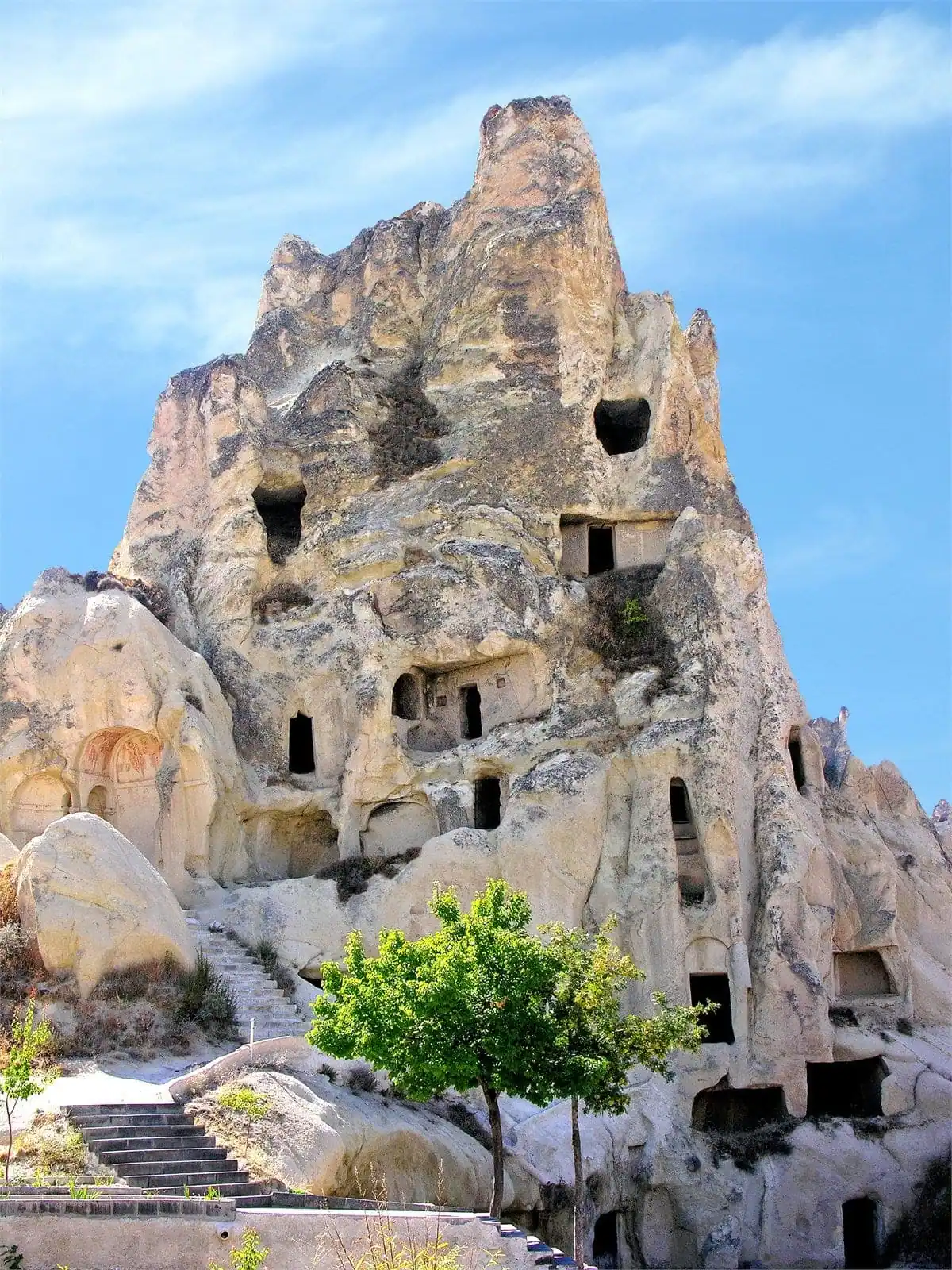
Cappadocia’s history is easiest to hold as a single idea: this is a soft-rock crossroads on a hard continent. Armies, faiths and caravans crossed the Anatolian plateau for four millennia, and whatever each era needed — temples, hideouts, churches, warehouses, hotels — the tuff obligingly became. The region’s biography is written in negative space: you read it by what was hollowed out.
Bronze, horses and Persians
The Hittites, Anatolia’s Bronze Age superpower, held these plateaus from around 1600 BC — their pottery tradition survives in Avanos to this day — and after their fall the region passed through Phrygian and Median hands to the Persian empire, which gave it the name that stuck: Katpatuka, traditionally read as "land of beautiful horses". Cappadocian horses paid Persian tribute and pulled royal chariots; their descendants still graze the valley floors, posing for etymology. Alexander swept the Persians away; a local dynasty then ran a semi-independent Kingdom of Cappadocia for three centuries until Rome, with characteristic patience, absorbed it as a province in 17 AD.
The Christian plateau
Christianity reached Cappadocia in its first generations — the region is addressed by name in the New Testament — and found in the rock a perfect incubator: remote, carveable, defensible. The 4th century gave the faith its local giants, the Cappadocian Fathers (see the churches article); the 7th to 10th centuries, under Arab raids, drove the population periodically into the underground cities; and the calmer 10th to 12th centuries painted the golden age onto chapel walls across Göreme and beyond. When Byzantine power failed at Manzikert in 1071, the plateau changed keys rather than stopping.
Caravans and coexistence
The Seljuk Turks made 13th-century Cappadocia a Silk Road corridor, studding the roads with fortress-inns — the great caravanserais at Sultanhanı and Sarıhan still stand a day’s camel-walk apart — while Christian and Muslim communities shared the valleys in workable peace; Ihlara’s Kırkdamaltı church, painting a Seljuk sultan beside the Byzantine emperor, is coexistence recorded in pigment. The Ottomans inherited a quiet province of farmers, potters and pigeon-keepers, Christian villages carving churches with Turkish inscriptions, until the 1923 population exchange ended sixteen centuries of Cappadocian Christianity in a single administrative stroke — the abandoned villages of Çavuşin and Mustafapaşa are its monument.
Rediscovery
The modern chapter is improbably recent. Travelers and scholars "found" the churches in the early 20th century; a householder’s wall found Derinkuyu in 1963; UNESCO listed the region in 1985; and the first commercial balloons rose in the 1990s, giving an ancient landscape its newest ritual. Today’s dawn — a hundred balloons over valleys the Hittites farmed — is simply the latest layer, and locals watch it with the same proprietary calm their ancestors presumably reserved for passing empires. Walk the whole four thousand years in a day with a guide who grew up inside them.
Sources & further reading
- Britannica: Cappadocia — the historical sweep
- UNESCO listing (1985) — the modern turning point
- Britannica: Cappadocian Fathers — the theological chapter