
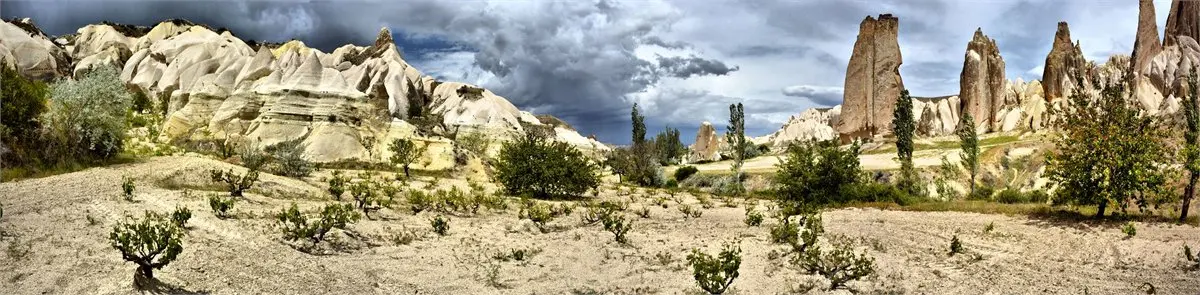
After two days of ochre rock and dust-dry valleys, the Ihlara gorge reads like a typographical error: a green slot in the plateau, one hundred meters deep, floored with poplars, frogs and the busy brown Melendiz river. It is the place Cappadocia goes to cool down — and it has been that for at least fifteen centuries, because the cliffs on both sides are drilled with monastic churches.
The gorge runs fourteen kilometers from Ihlara village to Selime. Almost everyone walks the middle third — down the famous staircase from the Ihlara entrance, along the river to Belisırma village — which packs in the best churches, the prettiest river stretch and a teahouse exactly where morale requires one.
The churches in the walls
Monks reached Ihlara early, and its isolation bred a local style: several churches here are painted in an eastern idiom — flat, vivid, Syrian- and Egyptian-influenced — that looks nothing like the polished Constantinople manner of Göreme’s Dark Church. The Ağaçaltı (“Under the Tree”) Church near the stairs keeps a wonderful Magi scene and a zodiac-like Last Judgment; the Yılanlı (Snake) Church shows sinners beset by serpents with unembarrassed directness; the Kırkdamaltı Church near Belisırma holds a rare portrait of a 13th-century Seljuk sultan alongside the Byzantine emperor — two empires sharing one wall, as they briefly shared the valley.
Walking it
The entrance staircase — several hundred steps — is the only real work; the valley floor is flat, shaded and kind. Four kilometers at church-visiting pace takes about two hours. At Belisırma, tables stand on platforms in the river itself, tea and gözleme arrive, and on our Green Tour the vehicle meets you there so the staircase is downhill-only. Spring wildflowers and October poplar-gold are the valley’s two show-off seasons; high summer is fine — the gorge shades itself — and winter walks are for the well-booted.
Sources & further reading
- Britannica: Cappadocia — regional overview
- UNESCO: Rock Sites of Cappadocia — heritage framework